Sunday, July 21, 2013

Day Lilies in Bloom!

The day lilies bloomed today on Layton.

Since the first violets spread across the lawn in April and the forsythia burst into vibrant yellow, each flower in the yard has had its week or two "in the sun" on glorious display. Daffodils peeked through the cold earth, glad to have weathered the last of the frigid temperatures. Then the lily-of-the-valley crept around the backyard with their tiny white bells tinkling silently.

Three delicate pink azalea bushes proclaimed their survival through the bitter winter of the North while the lilacs popped wildly in deep purple and snowy white from overgrown trees bordering the yard. One hung heavily with flowers like a crop of ripe grapes ready for harvest. Their aroma wafted richly around the neighborhood.

No passerby could ignore the rhododendron, the "in-your-face" queen of spring blooms. Each flower the size of a small child's head, the purple-pink handfuls of loveliness dominated the yard's color scheme. Every yard seemed to boast a massive pile of rhodies.

Almost simultaneously, the pink roses joined the peonies in a glorious display. Nestled beside the peonies, testament to my poor planting judgment, the roses outdid themselves this year in size and quantity. The peonies, a last hold out from my grandmother's garden planted over fifty years ago here on Layton, boast a rare maroon shade that is nothing short of breathtaking. The peonies are the flower I await impatiently, perhaps because they represent my grandmother. The Chinese adore the peony. They know and appreciate imperial and royal beauty. Many of their scroll paintings feature peonies; I bought such a scroll on a visit to China, and I enjoy the image of a peony all year.Their beauty in my yard is short-lived. They often succumb to heavy rains that cause the luxurious petals to fall limply. Even the roses paled beside the peonies.

The elephant-ear hosta leaves spread three feet in every direction, a natural tent for my grandsons' hide-and-seek games. Tall shoots, bearing white flowers, begin to climb out of the depths of the hosta to open banner-like in early July. Next to the hosta the astilbe form a defensive front to the encroaching daisies, which cannot be contained. The gentle, pink plumes of the astilbe wave delicately, a driveway border and eye-catcher.

Summer is in full swing. The half-century old tiger lilies return for one more season, another inheritance from my grandmother's garden. The tiny buds on the tomato plants, zucchini, beans and peas look promising. August may bring a sweet harvest.

My gardens leave me in awe. Each year the cycle continues, unchanged, each flower taking the stage at its appointed time. The plan has never varied in my fifty years of observation. I consider the beauty, the constancy, the creativity and imagination in  the making of a flower, and I am convinced yet again of the presence of the Creator and His faithfulness and constancy. The flowers display His character - filled with beauty and goodness, exemplars of supreme creativity. In my garden I stand -  in awe of its Maker.

And today the day lilies bloomed!

And they bloom, as their name obviously suggests, just for a day. In the morning dew I check the garden and there they are - faces upturned, stretching their purple and cream or purplish-rust or neon yellow arms in every direction. Their beauty screams away at the corner of my house all day, demanding attention. But when the sun sets and the cool of night draws over the yard, the day lilies curl up and shrivel away. The next morning they are gone, replaced by the bud further down on the stem which, in its turn, now tilts its face upward and splashes its glory everywhere . . . for a day.

Psalm 144:4 says, "Man is like a breath; his days are like a fleeting shadow." The day lilies remind me that our lives, in the scheme of history, are like a breath, blooming for a day and passing quickly from the earth. Day lilies adapt to various soil and light conditions, can survive in a wide range of climates, are suitable for all landscapes, and even tolerate drought. Are our lives facing the day with the same resilience and strength? Like the other flowers in my yard, the day lily's loveliness is not an accident. The Master Gardener tends His garden with provision and care; the day lily wisely rests in His sovereignty.

For our "moment in the sun," can we rest in our Maker's care? Can we trust Him to bring the sun, the rain, strength and resilience? For our moment in the sun, I pray that we can bloom like the day lily - face upturned, arms stretched in every direction, screaming gloriously a reflection of His beauty from our corner of the yard . . . 
On Layton.


Thursday, July 11, 2013

Book Review: Healing Hearts by Dr. Hisashi Nikaidoh, MD


Hope for Broken Hearts in
Healing Hearts by Dr. Hisashi Nikaidoh
with Janis Leibs Dworkis
Published by Ambassadors International, Greenville, SC

A gift, wrapped in tears and grief and enveloped in the love of God – this is the essence of Healing Hearts by Dr. Hisashi Nikaidoh.

The gift of this book comes not only from Dr. Nikaidoh but also from the eight mothers who have shared their stories and the stories of their children. Each of these women had a child with a traumatic heart situation which brought them under the care of Dr. Nikaidoh, a pediatric cardiologist. Each of them suffered extreme loss, grief, and pain at the death of their children. The death of their children plunged them into an abyss of grief but culminated, with time, in healing. Here is the hope of Healing Hearts: the excruciating pain of a child’s death does not have to consume and destroy a parent’s life.

Although Healing Hearts is a sad and difficult read, it is a necessary story. Parents of deceased children need this hope for their lives. They need to know that hope and joy are possible even after a tragic loss. Healing Hearts provides the inspiration we all need to experience hope in the face of pain and loss. The lesson gleaned from Dr. Nikaidoh and the women in this book is that hope can be found in giving and service to others. Their lives are proof.

Linda Balcioglu, Julie Williams, Linda Simpkins, Karen Ellis, Shanna Shields-Thomas, Marie Crowe, Lynette Dick and Liz Etzkorn exemplify the power of God to heal and turn ashes into beauty. Although the pain will never leave them completely, they have learned to manage their hurt by giving back to the world. Each of the eight women rises from the mire of grief by discovering that service to other human beings brings the salve of healing to their wounded hearts. Serving others - this is their common denominator.

Dr. Nikaidoh, who has spent over fifty years healing the hearts of his small patients, admits, "The medical profession will not be able to bring a physical cure to all patients, but God is not limited and will provide what we need." He credits the Great Physician and Healer for healing the hearts of these mothers . . . and his own.

A compassionate and caring doctor who wrote notes to the parents, visited their homes, and attended the funerals of lost patients, Dr. Nikaidoh came to understand personally the pain of a child's death. In the first chapter of Healing Hearts, he recounts the story of his son Hitoshi. Hitoshi's untimely death, shortly after finishing medical school, devastated his father and the family. Hitoshi had been dedicated to the true mission of a physician -  to serve. Dr. Nikaidoh, who had previously kept a respectful distance between himself and the grieving parents of his patients, realized that parents were not only mourning the child they had known. They mourned the child's future, the lost potential, the lost opportunities, and their hopes and dreams for the child.

The events of the book take place primarily at Children's Medical Center in Dallas, Texas, where Dr. Nikaidoh worked for 31 years. And it was to Children's, the site of their greatest loss, that all of the women eventually returned to volunteer or to join the hospital staff in helping other parents and children face the trauma of illness and death.


After the death of her son Timothy, Lynette Dick said, "I would like to think that . . . even if God had allowed us to keep him for a natural lifetime, I would still be a sensitive, helpful person who could empathize with others. But as I walk through the halls of this hospital every day, I know that I have something unique to give because of the loss of Timothy . . . the empathy, the tiny bit of peace that I can give them (other parents) is something not many people can offer. I wouldn't be able to do it either, if it hadn't been for Timothy."

Liz Etzkorn acknowledged God's role in her healing after the death of her daughter Brooke. "It is only with God's love and grace that any of us moves forward," she said. "By far the biggest lesson I learned from Brooke's life and death is this: God is in control. Not me, but God . . . I know now that God's plan is way beyond anything I can see on this earth. He is in charge. He knows what's best. And for that I am truly grateful."

Karen Ellis wrote about her job at the hospital, "More than twenty years ago when I first took that job as a receptionsist, I really hated the idea of spending any more time than I had to at Children's. I took the job because I needed to get back to work, and that was the work that fell into my lap. I figured I could tolerate it. But of corse, I've come to realize that this is exactly where God meant for me to be. Phillip (her son) taught me so much . . . it's now my blessing to put it all to such good use."

Julie Lakey Williams concluded, "I'm not sure one person can ever fully understand another person's feelings, but you can offer valuable empathy from having walked that same road before." Julie completed a round of her clinical nursing studies at Children's Medical Center on the fourth floor, exactly where her daughter Kimberly had been cared for before her death.

Dr. Nikaidoh concluded, "Healing Hearts is not about the failure to save these children. The book is about success - the success of these mothers who went on to serve others in such wonderful ways, always inspired and led by the memories of their precious children. I want to give these mothers all the honor they deserve, so that their stories of love, faith, and success can inspire all of us."

This is a book for anyone who has ever experienced pain. Dr. Nikaidoh and dear ladies,
we ARE inspired. 
                                                                                Dr. Hisashi Nikaidoh, MD, 
                                                           author of Healing Hearts, pediatric cardiologist, and
                                                                                             Christian

In the foreword to the book, Dr. C. Everett Koop, former Surgeon General of the United States, wrote, "After talking with Dr. Nikaidoh, I felt that his book would send a clear message about 'a plan beyond human understanding,'  i.e. 'the Sovereignty of God'. Books of this genre, and especially this book of Dr. Nikaidoh's are a testimony to the power of God without the appearance of preaching. Dr. Nikaidoh is not ashamed of this gospel for 'it is God's power for salvation to everyone who believes... (Romans 1:16)'."

For more information on Healing Hearts and information on how to purchase the book visit thehealingheartsbook.com.


Tuesday, June 18, 2013

WONDERSTRUCK!

 WONDERSTRUCK . . . on Layton!  
My "Wonderstruck" Companions

Thirty-six years ago I invited Jesus into my life, and my "wonderstruck" journey began.

It began with Bible study. And throughout these years Bible studies became a focal point of my life. Bible studies motivate, convict, direct, comfort, challenge, and inspire me. In God's Word I have come to know this One who is God and loves me gracefully, mercifully, and completely, this One who promises never to leave or forsake me, this One who forgives and saves a sinner like me.

During May and June I joined ladies in our church again to read God's Word through a lovely study called Wonderstruck: Awaken to the Nearness of God by Margaret Feinberg (Lifeway Press, Nashville, Tennessee).

Margaret defines "wonder" as being awed by the presence and action of God in our daily lives. She encouraged us to live "eyes wide open" to see God's handiwork, His blessings, and His presence. Each day we watched expectantly for God and recorded three wonders in our journals. "Wonders" like the scent of a newborn child, a fading sunset, a word of kindness, the crunch of an almond, or much-needed rain. We were never disappointed.

We found God everywhere, all the time . . . at sunrise and breakfast, in the garden and the workplace, on a train to Indiana, in a school classroom, with an old man and a pre-schooler.

Our experience confirmed Psalm 40:5. "Many, LORD my God, are the wonders you have done, the things you planned for us. None can compare with you; were I to speak and tell of your deeds, they would be too many to declare."

We discovered that we live at breakneck speed. We miss the hand of God as surely as a car, hurdling down the highway at 70 mph, misses the delicate beauty of a daisy beside the road. Apply the brakes, open our eyes, wait expectantly, and be surprised by His wonder. These lessons resound in our hearts as we seek to develop the discipline of seeing God.

"There He is . . . in the yellows, purples, pinks of spring flowers! There He is . . . in that unexpected phone call from an old friend! There He is . . .  in the lavish gift of supplies for a missions trip!" We have savored His sweet presence with us, we have recognized His divine handiwork, and we are awed. "Who among the gods is like you, LORD? Who is like you - majestic in holiness, awesome in glory, working wonders?" Psalm 17:7.

The youngest member of our Bible study (on his mommy's
lap) left us "wonderstruck."
 This readiness for discovery wets our appetites for a more vibrant intimacy with God. We awake, curious to know Him more. A. W. Tozer's sentiments become our own. "I want the presence of God Himself, or I don't want anything at all to do with religion. I want all that God has or I don't want any."

Thank you, Margaret, for helping us to live "eyes wide open." Thank you, lovely ladies, for your companionship on the journey. Thank you Jesus.
YOU leave me WONDERSTRUCK . . .
on Layton.
A mother-daughter team (first and second on right) study
God's Word and seek Him, together. Beautiful . . . and
Wonderstruck.


Thursday, June 6, 2013

This Summer . . . Off Layton!

 Every spring, excitement builds as plans are made for summer trips that will take me figuratively, not literally ... off Layton.

During February to May, letters arrive on Layton from people who desire to serve God somewhere in the world on missions trips during their summer vacations. Some want to "love on" little ones in orphanages; others will dig wells; a few will teach English or the Bible. All of them demonstrate a heart of love for God and people. All are willing to sacrifice their beach and relaxation time to let their faith be set in motion around the world. I'm awed by their love and commitment and eager to jump on their support team.

This summer I'm "traveling" with five of the finest young people I know, my 2013 Heroes of the Faith.

Sarah Allen is currently in China with the
 Yi people.
One of them is Sarah Allen. Her desire is to introduce children to the love of Jesus. She will spend the summer on the streets and in the churches of Philadelphia teaching Good News Clubs with Child Evangelism Fellowship. But before her summer work in Philly begins in late June, this teenager traveled alone to the mountains of western China to work in a school with some of the poorest children of the minority Yi people. For six weeks Sarah is teaching the Bible and English to 150 orphans at the school. Sarah said, "The best occupation in the world is being a fisher of men. I can't wait to see how God's hand will work this summer." What courage and trust in God! Sarah is still in China.


Ben Williams with his grandparents
And then there's Ben. I've known Ben Williams since he was a toddler in our church. Now, his physical stature and his faith and devotion to God are heights for the rest of us to attain. Ben will spend several weeks this summer in Dearborn, Michigan, of all places. Dearborn has a large Muslim population, and Ben will witness to Muslims there. He said that God has confirmed to him in several different ways that he should be part of a group that would break the power of Islam in the world. "Your guess is as good as mine as to what that means!" Ben writes, but his intention is to go into full-time missions in the Middle East when he finishes his education at Liberty University. His desire is to take the transforming love of Jesus to places where that news has not yet been proclaimed.


Jill Hart and Corryn Klien, center,
with Jill's husband and daughter Rachel.
Could a mother and daughter have a better bonding experience than one that will put them in a foreign culture together on the forefront for God? Jill Hart and Corryn Klien, a mother-daughter team, will join a group traveling to China for English camp in mid July. They will teach English everyday for two weeks to middle and high school students. There will be many opportunities to form relationships with Chinese students and witness of Christ's love. Jill said, "One of the coolest parts about being able to travel to China and be a part of this team is...Corryn wants me to go with her! I know that God will use us however He wants. Pray that we will have one-on-one opportunities to share the gospel with some of our new Chinese friends." I taught at English camp in China several times, and I am following these two lovely women every step of the way. I can see the classroom and hear the excited laughter of the students. Perhaps I should have planned to board the jet with Jill and Corryn.


Elisabeth, on the far right, is pictured with
her grandmother, sister, and mother.
And finally, Elisabeth Phillips is another of my Heroes of Faith this summer. Elisabeth just completed ninth grade. She is going with a former teacher to South Africa for the month of July. They will minister at Dayspring Children's Village, a boarding school which provides orphans and other disadvantaged children with a loving home as well as a quality education. Elisabeth writes, "I will be helping the children with school work, teaching them how to read music and play the piano, and showing them God's love."


One of the letters received on Layton said, "I want God's name to be glorified in all that I do. I want to be completely drenched in His presence so that the people I come across will be drawn to His glory. My prayer is that when you read this letter, you will not see me, but Jesus and only Jesus." Dear young ambassadors for Christ, Jesus is seen in you.

Sometimes, the greatest blessing isn't at home, but in some distant and exotic place (even Detroit). . .
off Layton

Friday, May 24, 2013

Memorial Day 2013 . . . or is it 1957?

A 1957 backyard picnic on Layton. The author is first on left.

.

It’s Memorial Day weekend, and I’m enjoying the view on Layton.

            The lawn, thick and green with last night’s rain, awaits my Toro. Several mowers can be heard up and down Layton. Families of wrens, robins, and chickadees have called the Justus Symphony Orchestra to concert in the old oak, whose arms have draped over Layton for a hundred years. The cat lies lazily in the shade of the picnic table, swatting listlessly at low-flying bugs. The cukes, tomatoes, and beans peek through the soil of my small raised-bed garden. The Adirondack chairs under the sprawling maple in the rear of the yard sit like thrones, presiding regally over this small world.

 It could be Memorial Day, 1957. The view from my porch hasn’t changed much in the past fifty years.

            Fifty years ago this already-old house buzzed with picnic preparations. Memorial Day launched the summer season when the city cousins from North Scranton trekked “up the country.” The extended family came every weekend in the summer for all-day backyard cookouts, to escape the city heat, and to “kibbitz” with the family.
           
In those days this house, on whose porch I sit these fifty years later, belonged to my grandmother, Nana Evans, known as Aunt Ethel to the cousins. My mom, dad, sisters, and I lived in the house next door to Nana here on Layton. Our two yards converged with plenty of room for children to grow up.

Summer preparations began in earnest for this first picnic of the season. Dad washed off the metal glider, pulled out the aluminum yard chairs and rethreaded their frayed nylon seats.  He hammered the badminton net into place, rehung the tether ball, and filled the grill with charcoal. “Annie, where’s the . . . ?” Dad called intermittently to my mother in the kitchen. “Annie,” a whirling dervish in her own right, swept about the kitchen preparing her favorite jello mold recipe and macaroni salad.

The coming of the cousins brewed high excitement.

            Nana and her sisters, Aunt Peggy, Aunt Ruthie, and Aunt Millie, reigned as matriarchs of the brood. Aunt Ruthie lived in Chinchilla. Aunt Peggy lived on Margaret Avenue near her daughter Peg; her son Bill lived just a street over on Edna Avenue in Scranton. Aunt Peggy’s other son Bob and his wife Mickey had moved after World War II to that haven for post-war vets, Levittown, in search of a job that didn’t involve the coal mines.

All of the men of those two generations had put in some time in the mines: Grandpa Evans spent most his working life in the mines; Uncle Gordy, Aunt Peggy’s husband, Aunt Ruthie’s husband Uncle Victor, and Aunt Millie’s husband Uncle Cliff had their hands to the pick and shovel until the demise of the industry. Even my dad earned his first paychecks from the Olyphant breaker. Summer afternoons in the country gave them a chance to blow off the soot and breathe fresh air.
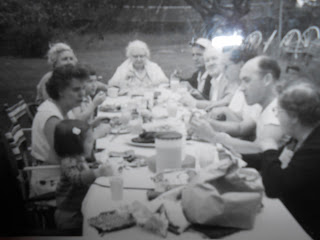
Summer picnics with the family on Layton, 1957.

            Aunt Ruthie didn’t have any children, but Aunt Peggy’s children and grandchildren made it a party. We had cousins in every age group from Peg’s three girls, Lynn, Beth, and Lori to Bill’s children, Glenny, Phil, and Les. Sometimes Bob and Mickey came up from Levittown. When Bob’s family came, the excitement and activity increased with his twin sons Bob and Bill and daughters, Joan and Gail. Our cup overflowed with cousins and a bevy of adults to supervise. Everyone had a buddy.

The ghosts of memories dance around the yard this Memorial Day: I see Phil hiding behind the front hedges in our twilight hide-and-seek game. The twins clank the lids on their jars as they corral lightning bugs. “Hey, Joey,” Sid yells to my dad as he slams the birdie over the badminton net and into the lilac bush.

Nana and her sisters laugh and talk simultaneously at high volume under the shade of the apple tree. Mom runs in and out of the kitchen with tablecloths and food. “Annie, don’t forget the ketchup. The dogs are ready!” Dad announces to the yard in general as Jiggsy, our beagle, runs between legs, seeking what he might devour.

One year Glenny ripped open her leg on the chicken wire around my dad’s new seedlings. The pitch of the old aunts’ cackling went up a decibel as Glenny was rushed off to the emergency room for stitches.

Another year Sid won our hearts when he took all us kids horseback riding up Layton at Bill Jones’s riding stable.

Gail, Glenny, and I would swing on the front porch glider, sharing secrets about our parents and boys.

If there weren’t enough paper plates, my mother, never a slave to fashion, was known to rip them and serve the kids on half plates.

Bill’s wife, Miar, always managed to bring the winning covered dish delight. A bit more avant-garde than the rest, she actually searched out recipes and bedazzled our taste buds.

At the end of the picnic day, our family stood around the yard saying good-byes, planning the next week’s picnic, hugging, and waving the cousins off to their distant homes in Scranton. A satisfied sense of belonging and continuity tucked me into bed although I doubt if I could have identified the reason for my joy at that time.

Today the yard is silent except for the clatter and spontaneity of my memories. Nana and the Aunts, Peggy and Sid, Bill and Miar, Bob and Mickey, and Mom are all gone. I only see the cousins now at funerals. When we cousins see each other at these last goodbyes, it’s evident that the cousin bond was deeply forged in our childhoods. Phil and one of the twins, Bob, reminded me at a recent funeral, “My best childhood memories were in your yard.” Only Dad, at 91, remains of that earlier generation.

The cousins scattered to the wind when we began the migration to college. Most never returned to Scranton. Lynn married a Dutchman and moved to the Netherlands; Phil had a successful career with the FBI and then retired to Memphis; Les, an in-demand orthopedic surgeon in Kansas City, continues to practice; the twins, still best friend-brothers, live in Bucks County and juggle several enterprises; Gail had a knitting business for awhile in Pittsburgh, and Glenny suffers as the collective recipient of the family’s legendary struggle with diabetes. Most of us are grandparents now; all of us are senior citizens.

Still, I enjoy the view from my porch. The apple tree succumbed to lack of care. When it only produced quarter-sized apples, it met dad’s axe. The front porch glider has seen countless coats of paint, but it stands immovable, its steel frame too heavy to lift. The other day my grandson and I tried to find the tether ball pipe, implanted somewhere mid-yard, hoping to put it back in action, but it had sunk into oblivion. The chicken wire is gone as are the aluminum chairs, but they did have a long run through three generations, thanks to my ever-mending, ever-recycling father. We still enjoy badminton, though a series of nets have been short-lived. A modern propane grill eventually replaced the old red charcoal burner.

The yard is silent this Memorial Day. One of my sons and three of my grandchildren live in Indiana. Dad sold his house next door and moved to South Carolina. The echoes of memories resound from oak to maple.

But I . . . I continue to enjoy the view from my porch on Layton.

Saturday, May 11, 2013

Mother's Day and Birthdays

 Nana Jones

Mother's Day gets me to thinking about my son who made me a mother for the second time on Mother's Day weekend thirty-six years ago. So Mother's Day and birthdays have a conjoined significance.

We've had a healthy dose of birthdays here on Layton (as well as a healthy dose of mothers) for over 80 years . . . five generations worth . . . all kinds of parties for every decade marker and all the milestone ages in between. I distinctly remember an Olympics birthday for the Mother's Day son sometime in the '80s that had me constructing a challenge course around the entire yard. And who can forget the 16th photo scavenger hunt birthday party that had us driving teenagers throughout the area?

One of the most memorable birthdays here on Layton was Nana Jones's 80th. Nana Jones, my dad's mother, entered the world with the turn of the twentieth century, 1900, in Liverpool, England.  Recalling her age was never difficult as she rolled on in age with the year. So in 1980 I determined to give her a "girl" party for her 80th birthday, a party with best friends.

Nana (Winnie) Jones also lived on Layton about a quarter mile up the road. Almost all of her lady friends had spent their lives on this half mile of country road between the Mt. Bethel Baptist Church, where they attended, and Justus Corners. They raised their children and grandchildren together, they ran Old Home Day every year at Mt. Bethel, they crocheted granny block afghans, knitted sweaters, hats and mittens, cooked up a whirlwind for covered dish dinners, worked with the Ladies Auxiliary of the Justus Fire Company, and enjoyed visiting back and forth to rock on the front porch glider and finish off a pot of tea.

I knew all of her friends well. We lived in the extended family of a country village and attended the same church. Our lives intersected at every point.

Florence James was Nana Jones's best friend. Florence lived just two houses away from my grandmother. Short and petitely built, Florence was the antithesis of my grandmother's tall, strongly-built physique. I can't ever remember Winnie and Florence wearing anything except house dresses, always lightly flowered and neat, even when weeding their gardens.

Betty Priest lived in the house right next to my grandmother. Their back doors were separated by no more than 20 yards. Mrs. Priest came over my grandmother's almost every day for tea. Nana Jones never lost her British affection for tea with milk and a few biscuits. As a child I was fascinated by her skill of reading the tea leaves left in the cup. Good friends until Betty died, leaving a gap in my grandmother's life, they never called each other anything except Mrs. Priest and Mrs. Jones.

The Von Storch family, the premier farming family in Justus, lived just around the corner, and Minerva, the matriarch of the family, had raised a bevy of boys who romped the countryside with my dad and the Evans and Lewis boys. She knew how to handle rowdy teens and how to make the best pies in Justus. At a church dinner we vied for Mrs. Von Storch's desserts.

Mildred Baker lived on Layton but further up the big hill, and Beatrice White, of the legendary White clan who originally settled the area, lived over on Fairview. The women were united by age, family, church, the Justus Volunteer Fire Company, the Depression and the War. They survived as friends.

Florence, Betty, Minerva, Mildred and Beatrice (although I would never have considered calling them anything but "Mrs. ...) composed my guest list of best friends for Nana Jones's 80th birthday party - A Who's Who of 20th Century Mothers in Justus.

Held in my front parlor, an appropriate synonym for my living room, the party featured chicken salad sandwiches and several rounds of BINGO. But it was the conversation that intrigued me.

As the ladies arrived and sat around my parlor, the reflections about the house began. "I haven't been here since Ethel died . . . Oh, it was long before that since I've been here . . . We used to come often to play cards . . . I'll never forget the night of the funeral . . ."

I'd heard the story before from my mother and grandmother, but here sat the mothers of the neighborhood recalling an event in 1950 that left an indelible community impression - a funeral.

"The roof nearly collapsed . . .Water poured into this room . . .  The men had to get up on the roof in the rain and patch it up - quick . . . One of the worst storms . . . The casket sat right over there."

And the recollections continued of my Grandfather Evans's funeral. Grandpa Evans built this house on Layton. When he died suddenly of a heart attack on the cellar steps of the house he loved, his body was prepared for "viewing" and "laid out" here in the front room, probably very close to where I'm sitting now. Traditional custom of the day had people "viewed" in their own homes, rather than at a funeral home. A disconcerting thought, as the rest of the family lay upstairs in bed. It's not a custom that has carried into the 21st century. Thankfully.

The night of the "viewing," a storm hit that blew off the shingles, ripped up part of the roof, and brought gallons of water gushing down the walls to the parlor, and . . . into my grandfather's casket. The men of the family and the neighborhood rushed into action through pelting rain and wind, climbing to the roof and re-boarding and covering the holes. I didn't ask how they dealt with damage to the coffin and . . . Grandpa Evans.

The guests at Nana Jones's birthday party had attended the "viewing" here in my parlor, and they relished every detail in the retelling. Thirty years after the event, and it still made a great story for the neighborhood.

Mother's Day, birthdays . . . death days - all part of life here on Layton.

Oh, and Happy Birthday, Trev, from your Mom. You are a Mother's Day gift.


Wednesday, April 24, 2013

Shiny Days!


Some days shine.

Not just because the temperature reaches 75, and the sun finally spends an entire twelve hours glowing.

Perhaps the shining has more to do with sensibility rather than meteorology

Today was one of those days.

Could it have been aglow because I spent the day with my 92-year-old father, a pleasure few can enjoy? Dad drives the 700 miles between South Carolina and Pennsylvania on his own, he can walk without assistance, he golfs a mean 46 on nine holes, he hikes a mile every day, he looks 80 - tops, and he can complete a crossword faster than I can read it.

Or was it because we had breakfast out with neighbors? Good friends, pleasant conversation, the richness of relationship building with people we enjoy . . . not to mention the buttermilk pancakes.

Was it the two children in front of me on the airplane who had obviously never traveled before? They grasped their mother's hand on take-off, and when they became comfortable at altitude, they vied for the window to ooh and aah at every stretch of cloud. "Look," the girl gasped. "It's a city!" Unjaded travelers awed by the miracle of modern science.

Or could it have been that magical moment in the arrivals lounge in Wilmington, North Carolina? As we sat awaiting yet another long-delayed flight, I took to people-watching. The young soldier in dress uniform on the sofa cross from us was hard to miss. Over six feet tall and handsome, his demeanor belied his appearance. His fingers tapped endlessly on his knee, on his chin. He wiped his brow. His leg vibrated up and down. I thought perhaps he had just returned from the war; perhaps this was Post-Traumatic Stress Syndrome. And then a flight arrival announcement bolted him from his seat.

As he stood by the gate and watched the disembarking passengers, his tension grew. Finally, a perky, petite cutie with a crop of curly blond hair came through the gate in her pink and white sundress with a matching bag and sandals. Our soldier quickly wrapped his arms around her, a momentary kiss and a few words ensued, then . . . he dropped to his knee, all six feet of him, and he took her little hand in his. "Look, Dad!" I elbowed him wildly, but he was lost in a chess game on the NOOK. "Look!" By this time the entire lounge had zeroed in on the life moment unfolding before us.

We heard our soldier say, "Will you marry me?" A small box came out of his pocket. Our heroine said, "Yes!" and a ring was placed on her finger. He stood, lifted his arms to the heavens (and the arrivals lounge clientele) and boomed, "She said "Yes!' " Of course, we spectators couldn't get enough of this real life movie scene, and we burst into applause.

The bride-to-be jumped into his arms, and there was a twirling and hugging in the middle of the lounge. More applause. Joy all around.

Quickly, the couple moved off toward the exit. The moment united those of of us frustrated with airplane delays. No doubt, everyone's memories traveled to the day of our marriage proposals, our weddings, or our long journeys since then. And we smiled for the hope of newness and fresh starts and young love.

"She did everything right, " Dad remarked finally surfacing from the NOOK in time to see the action. "She even lifted her leg when he picked her up." A coquette indeed. A magical life moment shared by a room full of strangers.

Or did the day shine because of a special gift? As I sat in the megalithic airport known as Charlotte, awaiting the plane for yet another leg of my journey back to Layton (not an easy place to acess from distant points), I recognized a friend. A rush of joy and excitement always accompanies reunions in foreign arenas. "Cindy!" I yelled, and we hurried to embrace. Our mouths started clattering non-stop, and before we knew it, our flight was boarding. Old hands at travel, we didn't rush the gate but relaxed to wait for our zones to be called.

The clattering and chattering continued and . . .  somehow . . . we missed our call. The door to the aircraft had closed! How did that happen without our knowledge? In unison and before a crowd of hundreds at ten conjoining gates, we banged on the closed door. In hindsight, it was interesting that no security came to stop us or bind our panic. Instead, the gate attendant showed up with a grin. "Why, girls, they had cake at the next gate, and I just had to get me some! You're OK. Here, I'll change your seats so you all can sit together."  So the chattering, clattering, and add giggling to that mix, continued until we reached Scranton . . . where the sun rarely shines, but the friendship glistens.

Some days just shine . . . even when it's gray . . . here on Layton.